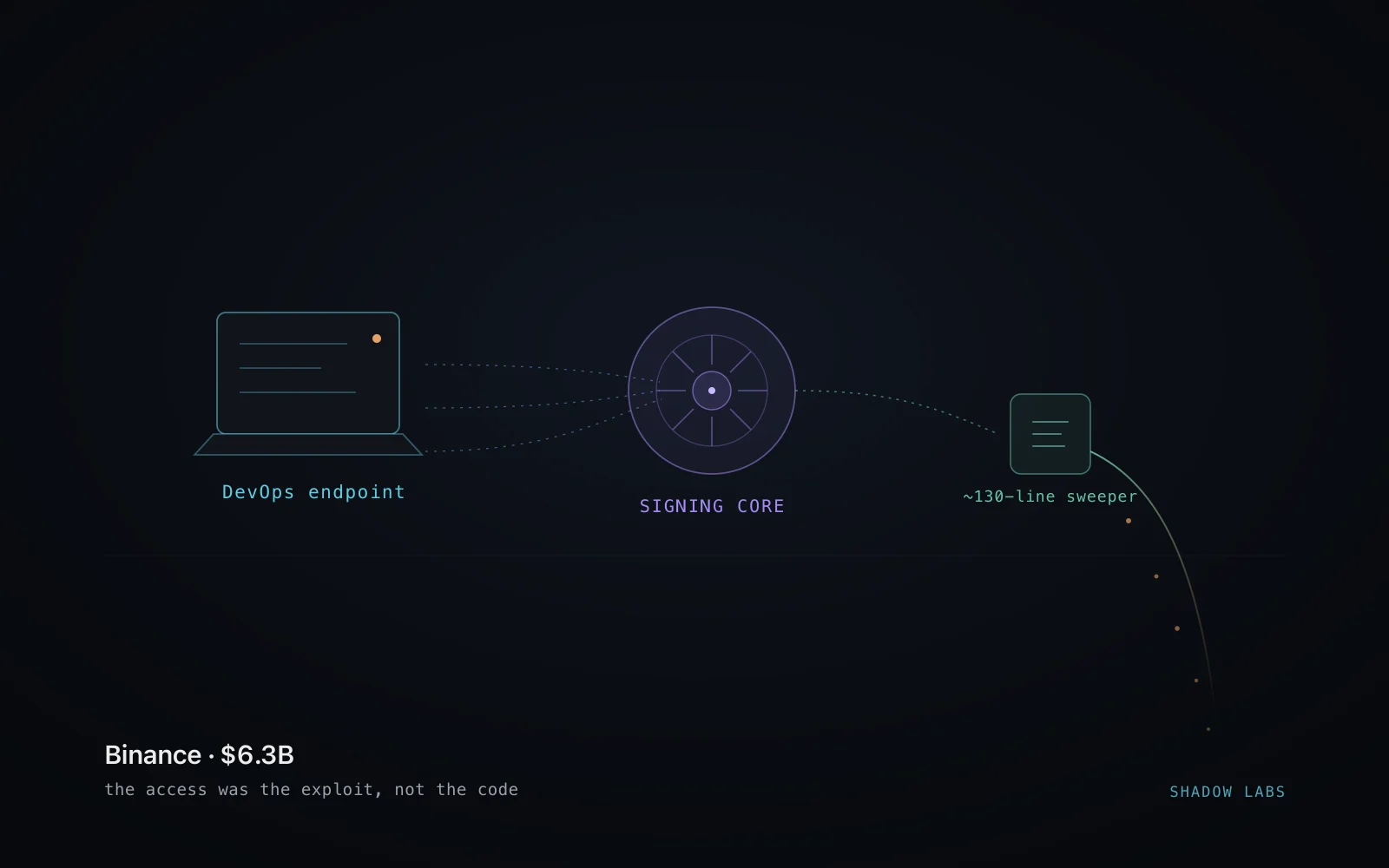

The largest crypto theft in history did not start with crypto. It started with a laptop. In the last days of October 2026, attackers moved about $6.3 billion out of Binance, the world’s largest exchange, across roughly ten blockchains and most of it inside 20 minutes. The on-chain code that moved the money was, by one analyst’s count, around 130 lines. The hard part was never the code. It was standing access to the systems that sign Binance’s transactions, and that access began at an engineer’s endpoint. The keys were never the real target. The room where the keys get used was. [Our assessment]
This is a breakdown of how it happened, who did it, and why the lesson reaches well past crypto. The facts come from the FBI’s public attribution and from reporting by The Block, NBC News and CNBC, which cite the blockchain-analytics firms Chainalysis, Elliptic and TRM Labs and Binance’s own statements. Where a claim rests on a single source or is still moving, we say so.
A North Korean playbook, maturing
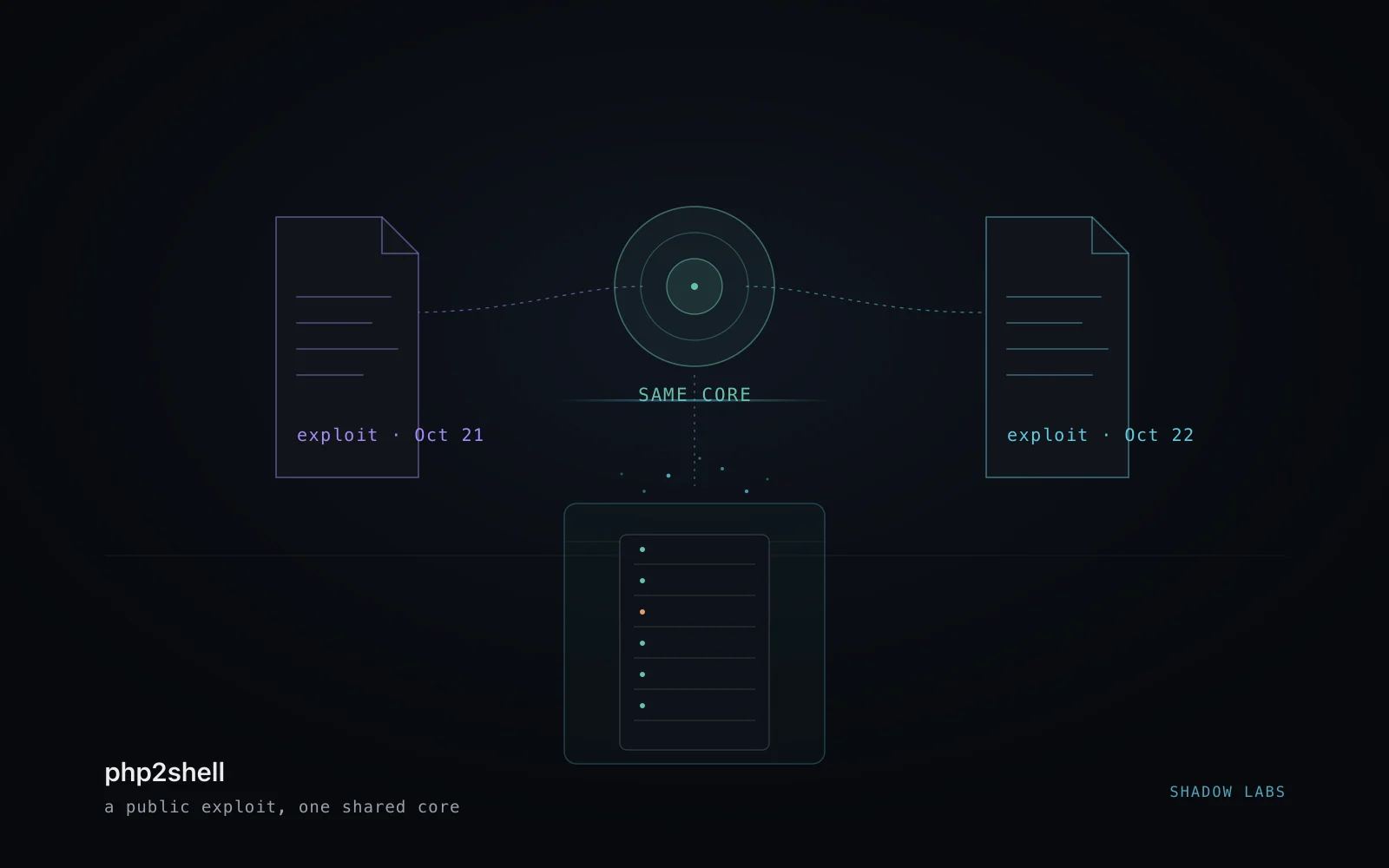
To read this breach right, put it next to the last record. In February 2025, about $1.5 billion was stolen from the exchange Bybit through a compromised wallet-management interface that led signers to approve a malicious transaction. The FBI attributed that theft to the North Korean cluster it tracks as TraderTraitor. [Confirmed] Twenty months later the same crew, by the FBI’s account, took more than four times as much from Binance, and it reached deeper, into the signing infrastructure itself, with a newer on-chain technique.
That trajectory is the story. The target is no longer the person approving a transaction, or a single wallet. It is the pipeline that decides what gets signed. Each operation has climbed further up the trust chain, and each has been bigger.
The way in: a laptop, not a zero-day
Binance’s initial investigation pointed to a compromised DevOps engineer’s laptop and unauthorized access to a service container, with no private key leak identified. The FBI described the breach as involving a compromised laptop and malware built to delete evidence of its own activity. [Confirmed] Co-CEO Richard Teng called it “more complex than a compromise of a single employee’s permissions.”
Read that carefully, because it is the lesson. The attackers did not steal a key. They reached the systems allowed to use the keys, and the processes that authorize a signature.
Why the vault held and the bank still lost
Exchanges spend enormous effort protecting key material, with hardware security modules and multi-party computation that split a key so no single machine ever holds it. Here is the uncomfortable part: none of that was defeated, and none of it helped. The attackers never needed the private key. They needed the signer to say yes. [Our assessment]
Custody protects the material. A different thing decides what gets signed: the authorization layer, the policy engine that rules which transactions are allowed, the co-signer quorum, the allow-lists and withdrawal limits, and the CI/CD and configuration that push those rules to the signer. That authorization layer, reachable from a developer’s endpoint, is the soft surface, and it is exactly what a red team probes on an exchange. Not “can I steal the key,” but “can I get the signer to approve what I want.”
The technique: turning the bank’s own wallets into sweepers
With that access, the reporting says the attackers abused EIP-7702, a 2025 Ethereum feature that lets an ordinary account delegate its behaviour to a contract through an authorization the account itself signs. Used as intended, it powers conveniences like paying fees in tokens or batching actions. The danger is not that an outsider can repoint your address at will; a 7702 authorization is signed by the account’s own key. The danger is whoever can make that account sign, which here was the compromised signing path.
Two details make it potent. First, the delegation is sticky. Once set, it stays in place until another authorization replaces or clears it, so a one-time ability to make an account sign becomes an automatic drain of every future deposit to that address, not a single transfer. The reporting describes exactly that: Ethereum hot wallets converted into an attacker-controlled sweeper, a contract of only about 130 lines, that moved funds out as they arrived. Second, the attackers pre-signed 50 authorizations. That separates the moment of signing, while they still had access, from the moment of execution, the sweep, so the operation would fire even if their access was cut or noticed.
As Immunefi’s Simone Imbrescia put it, “the hard part sometimes is getting access to a system powerful enough to make very simple code devastating.” That is why EIP-7702 abuse is worth tracking as its own emerging technique, not a footnote to one breach. [Our assessment]
The money trail
None of this was improvised. More than 36 hours before the theft, the operators funded a wallet with small withdrawals from the Tornado Cash mixer, then deployed and tested the code on three wallets before the main run. When the sweep began, roughly $6.36 billion moved across 10 blockchains, most of it inside about 20 minutes, and the laundering was fast and deliberate:
| Step | Reported action |
|---|---|
| Convert | About $325 million in stablecoins swapped to roughly $285 million in ETH inside a 20-minute window |
| Leverage | $59.9 million in stolen USDT deposited into Aave as collateral, then 19,762 ETH borrowed against it |
| Swap out | Hundreds of millions in USDT exchanged for ETH across DEXs and market makers, accepting up to 26% slippage |
| Move | Around $242 million routed through Tron |
Converting to ETH at speed and absorbing heavy slippage says the attacker valued finality over price. The outflow fanned into the laundering paths that on-chain investigators traced in near real time: USDT swapped to TRX through SUN.io on Tron, stolen USDT posted into Aave to borrow ETH, roughly $320 million of other tokens dumped on decentralized exchanges, and funds bridged through THORChain into a single address where they mixed with the proceeds of a separate $388 million Bitget exploit.
Step 6 of 6: Recovery. 90% replenished. Stolen $6.36 billion, frozen $2.80 billion, $3.56 billion still at large. Binance covers losses from its SAFU fund and reserves, and reopens withdrawals. Frozen is not recovered.
90% replenished
Binance covers losses from its SAFU fund and reserves, and reopens withdrawals. Frozen is not recovered.
Frozen, not recovered: the off switch in the money
Here is the twist that made this the rare mega-theft with a partial happy ending. Within hours, the stablecoin issuers began freezing. Tether locked about 1.76 billion USDT and Circle about 823 million USDC, with Ripple and others adding more, bringing the total frozen for the Binance exploit to roughly $2.8 billion. Binance said it had replenished 90% of the stolen assets from its SAFU fund and company reserves, committed to cover the rest, and reopened withdrawals on November 1. (Figures as of 2 November 2026; freezing and recovery are still moving.)
Sit with how that worked. The money was clawed back not by cryptography or by the speed of law enforcement, but because a large share of the loot sat in assets whose issuers can censor them. USDT and USDC have an off switch: the issuer can freeze an address, and can destroy and reissue the tokens. That is exactly why the attacker raced to convert into ETH and bridge across chains, to move value into something no one can freeze. It also reopened an old argument, that the same centralization which saved Binance’s users is the thing crypto was supposed to remove, and that frozen is not the same as returned to its owner. [Our assessment] For a defender the lesson is narrower and more useful: your incident response moves only as fast as the third parties who can actually freeze or claw back value. Know who they are for every asset and system you touch, and have the contact and the process in place before you need them, not during.
Who did it
The attribution here is unusually firm for a crypto theft. On 31 October 2026 the FBI publicly stated that the North Korean state-sponsored unit it tracks as TraderTraitor was responsible. [Confirmed] The analytics firms Chainalysis and TRM Labs independently reached the same conclusion, TRM calling it the largest hack in history. The on-chain investigator ZachXBT added the sharpest link: stolen Binance funds and the proceeds of a separate $388 million Bitget theft were bridged through THORChain and commingled at the same address, which points to one actor behind both, and the Bitget theft had itself been attributed to DPRK-linked TraderTraitor. Elliptic described the methods as consistent with TraderTraitor’s established playbook, the social engineering of employees, pre-staged signatures and rapid multi-chain extraction, while cautioning that on-chain overlap alone does not prove identical operators. A government attribution, concurring forensics from several firms, and a commingled money trail together make this about as well-supported as public attribution gets. [Our assessment]
One phrase in Elliptic’s description is worth underlining. The pre-staged signatures are the 50 pre-signed authorizations from earlier in this story: a signature of this crew’s tradecraft, not an improvisation on the day.
What comes next
The direction of travel is clear enough to plan around. [Our assessment] The access layer, developer endpoints, CI/CD, signing orchestration and cloud IAM, will keep beating smart-contract bugs as the way into funds, because that is where the leverage is. EIP-7702 abuse will spread from exchanges to wallets and custodians as more of the ecosystem adopts it. And as the largest exchanges harden their signing paths, the same playbook will move down-market, toward mid-size custodians, payment firms and regional platforms that hold real value but run leaner security.
This is not only a crypto problem
Strip away the tokens and the shape is one every security team knows. The valuables were not the keys; they were the systems and identities authorized to use them, reachable from a laptop. Map it onto your own environment:
| In the Binance hack | Your equivalent |
|---|---|
| Hot-wallet signer (HSM / MPC) | Your CA, KMS, code-signing service or release pipeline |
| EIP-7702 delegation to a sweeper | An OAuth consent grant, an IAM role assumption, a mailbox delegate rule |
| 50 pre-signed authorizations | Long-lived tokens, refresh tokens, cached credentials that execute later |
| DevOps laptop as the entry | Any endpoint with a path to production signing or deploy |
| Mixer-funded staging | Attacker infrastructure stood up before the move |
You do not run a crypto exchange, but you almost certainly have a system that signs or deploys on your behalf, and a laptop that can reach it.
What it means for Latin America
None of the primary sources breaks exposure down by country. [Confirmed] But the down-market drift is the regional risk. Exchanges, custodians and fintechs across the region hold meaningful crypto treasury with smaller security teams, and the same ingredients are usually present: developer laptops with production access, signing or deploy pipelines that few people watch, and cloud IAM that grants more than anyone audits. The 7702 maneuver is not what will take a regional platform down. The DevOps-laptop path is, and every company has one. [Our assessment]
If you run signing, deploy or treasury infrastructure
01Treat the signer and its policy as tier-0
The service that approves value transfers, and the policy that decides what it will approve, deserve the isolation, change control and monitoring of a domain controller. Access to them should be rare, logged and alerted.
02The endpoint is the perimeter
A laptop with a path to production signing or deploy is as sensitive as the signer. Hardware-backed auth, EDR, no local key material and isolation from general browsing and email are the baseline there.
03Watch for delegation, not only transfers
On Ethereum, an EIP-7702 authorization that points one of your addresses at an unfamiliar or newly deployed contract is a red flag. Alert on set-code authorizations, not just outgoing value.
04Put controls on pre-signed and batched approvals
Authorizations that can execute later need expiry, rate limits and reconciliation, so a stolen batch cannot be replayed on the attacker’s schedule.
05Assume staging is observable, in hindsight
Mixer-funded wallets, new operational addresses and test transactions often precede the move. You will usually find them in a retro-hunt, not before, so build that hunt now.
Could this be you?
The honest test is not whether your keys sit in an HSM. It is whether someone who phishes one developer can reach the thing that signs or deploys, and whether you would see it happen. That path, from an endpoint to a signing or release system, is exactly what a red-team engagement and an assumed-breach test are built to walk. If you want to know whether someone already has, that is a compromise assessment; and if you build the contracts or the signing code, a secure code review is where to start. The most expensive breaches are usually ordinary at the code level and sophisticated at the access level. This one cost $6.3 billion, and the code was 130 lines. [Our assessment]
7 sourcesnbcnews.com+6+4ShowHide
- 01nbcnews.com
FBI attribution, reported by NBC News and Fox Business: on 31 October 2026 the FBI named the North Korean unit TraderTraitor, and described a compromised laptop and evidence-deleting malware.
- 02theblock.co
The Block, Inside the largest crypto hack on record: the DevOps-endpoint access, the EIP-7702 sweeper, the 50 pre-signed authorizations, the laundering steps and Binance’s statements.
- 03cnbc.com
CNBC, What happens next: about $3 billion frozen, the SAFU fund and the recovery picture.
- 04npr.org
NPR, a simple explainer and TechCrunch, record $6.3B breach: scale, timeline and corroboration.
- 05x.com
ZachXBT on X, the commingling update and the frozen total: the Binance and $388M Bitget proceeds bridged through THORChain and commingled at one address, and the running frozen figure past $2.8 billion.
- 06finance.yahoo.com
Reuters via Yahoo Finance and CoinDesk: Tether froze about 1.76 billion USDT and Circle about 823 million USDC, the roughly $2.8 billion frozen, and the debate over censorable stablecoins and whether frozen equals recovered.
- 07cointelegraph.com
Cointelegraph: Chainalysis, TRM Labs and ZachXBT linking the theft to TraderTraitor, and Elliptic’s description of the group’s playbook (social engineering, pre-staged signatures, rapid multi-chain extraction).